
Living in Historic Downtown Orlando: College Park, the North Lakes, Delaney and Lake Eola Compared
Historic downtown Orlando is not one neighborhood, it is four. Brick streets, lakes and oak canopy tie them together, but the rules, the homes and the price ladder change from one ring to the next.
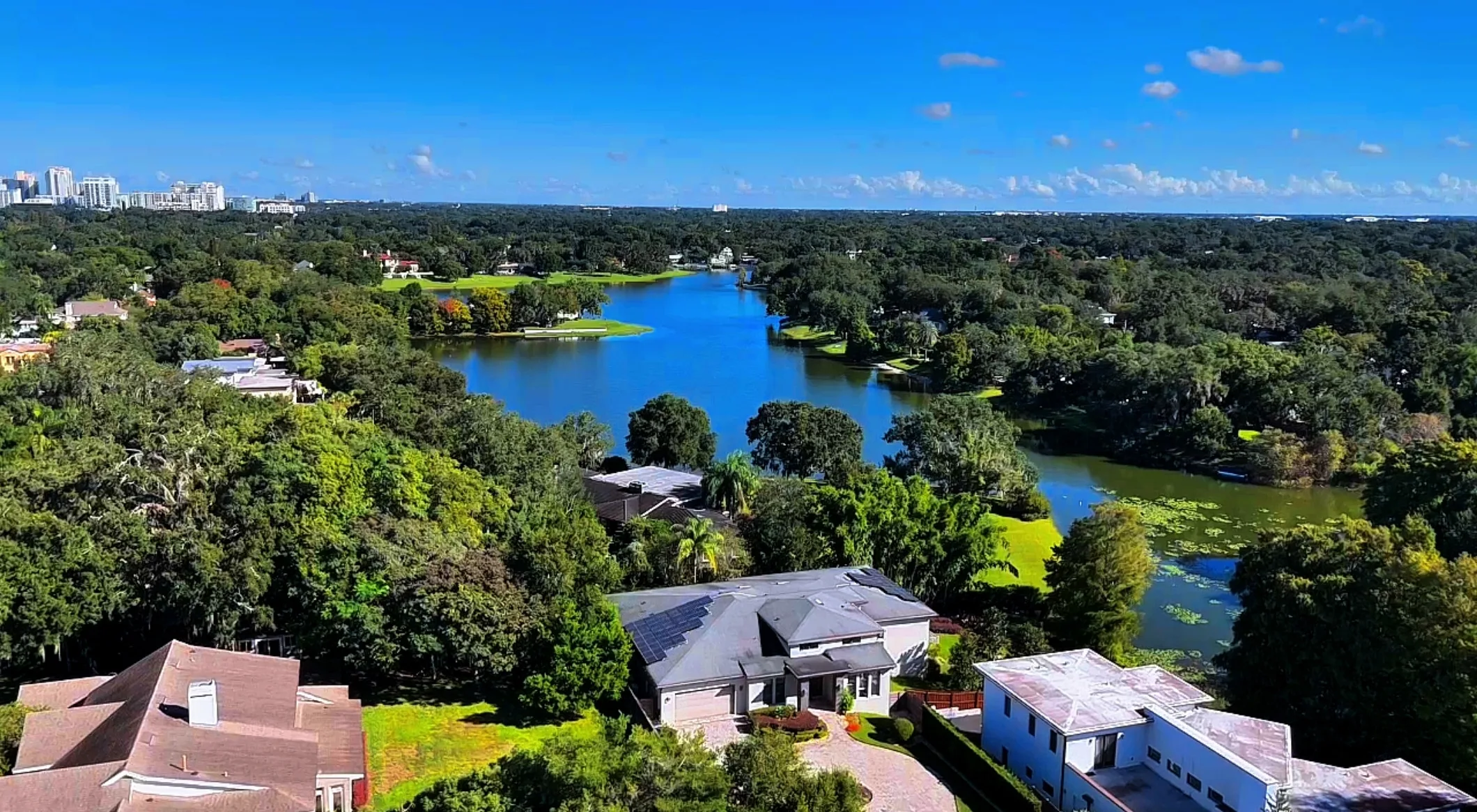
Lake Cherokee, a City of Orlando local historic district since 1981, sits minutes south of the downtown skyline.
What to Know
Historic downtown Orlando at a glance
Four areas, four rule books. Lake Cherokee, Lake Eola Heights and Thornton Park are local historic districts. College Park and Delaney Park are not, so rebuilds happen there.
Two eras of homes. Eola Heights, Thornton Park and Cherokee center on 1920s houses, while College Park and the North Lakes are mostly post-war.
Budget for age. Homes 70 to 100 years old need careful inspection, and insurance in the older ZIP codes can run well above the county average.
Living in historic downtown Orlando is really a choice between four different places. Jared Jones splits the old, close-in neighborhoods into College Park, the North Lakes of Orwin Manor and Rose Isle, Delaney Park and Lake Cherokee, and Lake Eola Heights with Thornton Park, and they do not cost the same, look the same or follow the same rules.
This guide follows the street-level tour and the numbers. If you want the short version first, our quick answer on what it is like to live in Orlando’s historic neighborhoods covers the basics in a few minutes. Here we go deeper on the price tiers, the trade-offs and how to match an area to the way you actually want to live.
Which neighborhoods count as historic downtown Orlando?
For this guide, historic downtown Orlando means the older, close-in rings that spread out from downtown, each built around lakes.
Jared’s map runs from College Park to the northwest, to Orwin Manor and Rose Isle on the North Lakes, to Delaney Park and Lake Cherokee just south of downtown, to Lake Eola Heights and Thornton Park around Lake Eola. These are City of Orlando neighborhoods with official boundaries, and that matters, because plenty of homes get marketed with these names while technically sitting somewhere else.
ZIP codes help you get oriented but they do not define a neighborhood. College Park is mostly 32804, the North Lakes are 32803, Delaney sits in 32806, and Lake Cherokee and Thornton Park are in 32801, with part of Lake Eola Heights in 32803. Jared points out that several pockets people casually call College Park are officially separate neighborhoods, so every College Park figure in this guide uses the official boundary.
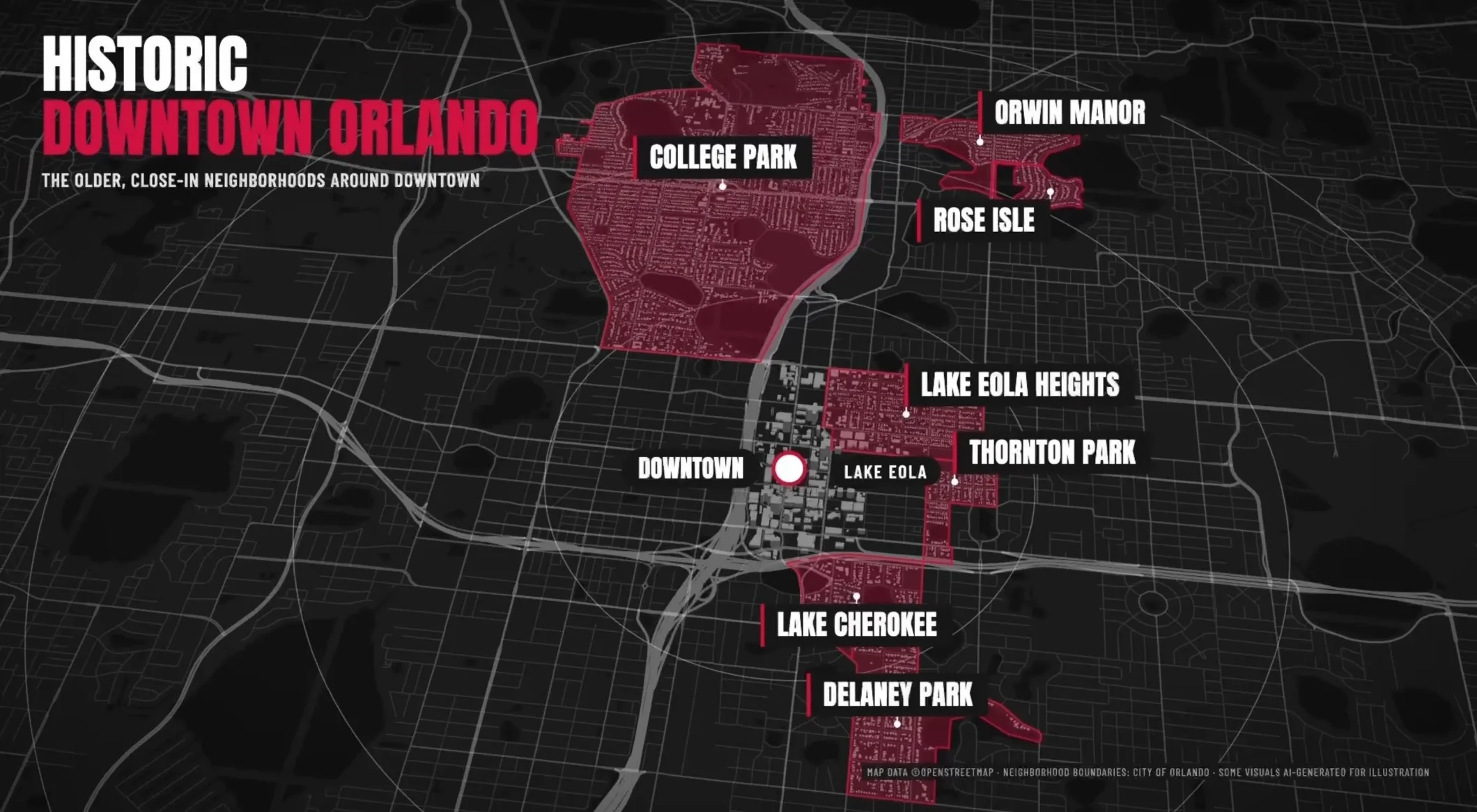
The four historic areas covered in this guide, drawn on official City of Orlando neighborhood boundaries.
Map data: OpenStreetMap contributors. Neighborhood boundaries: City of Orlando.
Why do Orlando’s old neighborhoods feel so different?
The short answer is history and rules: when each area was built, and whether a local historic district controls what can change.
These are Orlando’s first rings. They were platted mostly in the 1910s and 1920s around lakes, complete with brick streets and oak canopy. Developer Walter Rose put college names on early College Park streets in the early 1920s and launched Orwin Manor during the 1924 to 1925 land boom. He also wrote Florida’s real estate license law and chaired the first Florida Real Estate Commission, so, as Jared puts it, every licensed agent in Florida, himself included, works under a system that traces back to the man who platted these streets.

Walter Rose platted early College Park streets and Orwin Manor, wrote Florida’s real estate license law and chaired the first Florida Real Estate Commission.
Sources: National Association of Realtors, State Archives of Florida
The rule books came later. Jared explains that in the 1970s neighbors fought to save some of Lake Cherokee’s oldest homes, which helped build support for Orlando’s preservation ordinances. The City of Orlando lists its local historic districts as Downtown (1980), Lake Cherokee (1981), Lake Copeland (1984), Lake Eola Heights (1989) and Lake Lawsona (1994), which covers Thornton Park. Inside those districts, exterior changes go through historic review. If you are not sure how that differs from a National Register listing, our explainer on local historic districts vs. the National Register in Orlando walks through it.
College Park is the big exception. Its National Register districts work as an honor roll, not a design review district, so with no local district a bulldozer can show up in College Park but not on Cherokee Drive. That is why, in Jared’s 12-month review, almost one in five College Park sales was a home built after 2021, while Lake Cherokee had none and Lake Eola Heights and Thornton Park had one.
What sells also differs. Lake Eola Heights, Thornton Park and Lake Cherokee are true 1910s and 1920s neighborhoods with a median year built around 1925. College Park and the North Lakes are mostly post-war, with a median year built around 1954, plus College Park’s wave of new construction.
The edges of downtown are changing too. Jared calls out the Arena District, Creative Village and The Canopy, the park space under I-4, as reasons downtown’s west side is changing fast.

Downtown’s west side is changing fast, with the Arena District planned beside the arena.
Photo: CSLINTL.COM

The Canopy turns the space under I-4 into park land between downtown’s east and west sides.
What is it like to live in College Park?
College Park offers the most choice at every price point and a real main street, and it is also where most of the new homes in old Orlando are going up.
If old Orlando has a main street, Jared says it is Edgewater Drive, with restaurants, coffee and local shops. Behind it is the college-named grid of streets like Princeton, Yale and Harvard. Lakes frame the edges, with Lake Adair and Lake Concord to the south, Lake Ivanhoe to the east and Lake Silver to the west, and Dubsdread golf course sits to the north. Downtown is about 6 to 12 minutes away, with I-4 on the east edge. A bit of trivia: Jack Kerouac lived on Clouser Avenue in 1957 and 1958 and wrote The Dharma Bums in that small house.
Most of College Park has no mandatory HOA. The neighborhood association is voluntary, though deed restrictions and zoning still apply, so verify each property. Is it walkable? Within a few blocks of Edgewater, yes. Beyond that, Jared is careful not to oversell it. His summary: established and local without feeling like a museum.
College Park price ladder
Jared reviewed almost 240 College Park sales from the last 12 months.
- Entry, about 350,000 to 500,000 dollars: roughly 1,100 square feet, two bedrooms and one bath, sometimes three and two, built in the 1940s and 1950s. Post-war cottages, rarely a pool, none on the lake. He finds them near Dubsdread, out on the west side and on the smaller blocks of the college grid.
- Move-up, about 500,000 dollars to 1 million: the typical sale was around 655,000 dollars, up 6 percent year over year. Expect about 1,900 square feet, three bedrooms and two baths up to four and three, mostly renovated or expanded 1940s to 1960s homes. About one in five has a private pool.
- Luxury, most commonly 1.2 million to 2.4 million dollars: the top sale was 5.8 million. Expect about 3,300 square feet, mostly built in the last few years, with three out of four offering a private pool. Jared says this is the price point you need to be in to get something new here.
The under-500,000 tier is shrinking. A year earlier, 35 percent of College Park sales were in that range; now it is 28 percent, and the typical home under contract leans over 1 million dollars. Homes take a few more days to sell than in the other three areas, but sellers received about 98 percent of asking price over the past year.
Jared’s read: College Park is quietly trading small post-war cottages for new pool homes of 3,000 square feet and up, and the entry tier is the raw material for what comes next. That is great if you want choice and a main street. It is a problem if you want more yard for the money, or if a neighbor’s year-long build next door would bother you. Entry homes here are 70 to 80 years old, so budget for roof, plumbing, electrical and insurance diligence if you plan to keep the house. Edgewater Drive itself is also due for work, with a roundabout at Lakeview Street that Jared says is targeted to start in November and finish around September of next year.
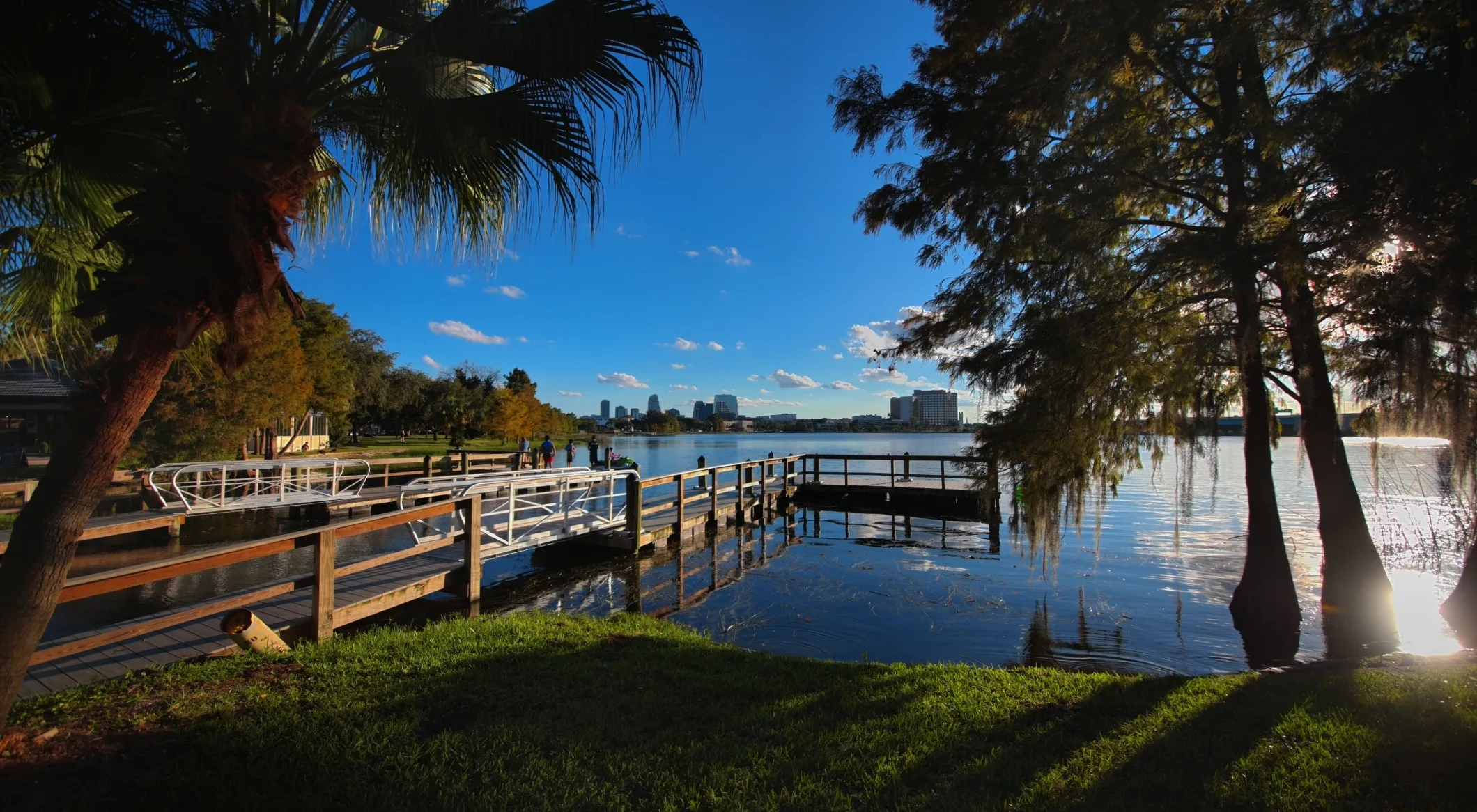
Lakes shaped how Orlando’s first neighborhoods were laid out in the 1910s and 1920s.
What is it like to live in the North Lakes, Orwin Manor and Rose Isle?
The North Lakes trade the main street for water: mid-century ranch homes on bigger lots, tucked behind Orange Avenue around a chain of lakes.
Lake Winyah, Lake Sue, Lake Estelle and Lake Rowena define this pocket. Jared notes you can drive down Orange Avenue every day and miss it, then make one turn and it is all trees and water. Orwin Manor, including Beverly Shores, which people often forget is part of it, wraps those lakes. Rose Isle sits on Lake Rowena and Lake Sue, with Lakeshore Drive as its signature street.
The homes are mostly 1940s to 1960s ranches with a median year built around 1954, and about six in 10 have an in-ground pool. Think mid-century lake living, not 1920s bungalows. This is also Walter Rose country. Jared notes that the original Orwin Manor stucco gates were restored and named a city landmark in 1990.
North Lakes price ladder
- Entry, about 650,000 to 900,000 dollars: 1,600 to 2,300 square feet, often three bedrooms and two baths, usually no pool, in Orwin Manor’s interior along streets like Nottingham and Pelham, away from the water.
- Move-up, about 900,000 dollars to 2 million: most sales landed between 1.1 million and 1.5 million for around 2,700 square feet, typically an updated 1950s ranch, and two out of three had a pool. Jared places these in Beverly Shores and the Rose Isle interior.
- Luxury, over 2 million up to about 3.5 million: roughly 3,750 square feet, either newer builds or 1950s homes on the water along Lakeshore Drive in Beverly Shores or on Westchester Avenue. Jared saw a 2,658 square foot home built in 1958 on Lakeshore Drive sell for 3.1 million dollars. You are paying for the lake, not just the house.
The better homes sell in days. In Jared’s review, median days on market fell from 9 to 4, the share selling at or above list price rose from 27 percent to 57 percent, and new builds above 3 million dollars are arriving in Beverly Shores.
It is a strong fit if you want water and quiet streets minutes from downtown, but the trade-offs are real: the highest price per square foot of the four areas and very thin inventory. The lakes limit the ways in and out of Rose Isle, there is a rail line to watch near Orwin Manor, and some original Orwin plats end up in a different jurisdiction, so check which address a property is really in.

The North Lakes, home to Orwin Manor and Rose Isle, hides lakefront streets just off Orange Avenue.
What is it like to live in Delaney Park and Lake Cherokee?
Delaney Park and Lake Cherokee touch each other but play by completely different rules, with brick streets and the skyline right over the trees.
Delaney Park is a quiet grid around Lake Lancaster, with the city park on Delaney Avenue, minutes from downtown and the hospital district. Jared addresses the common question head on: Delaney Park is not a local historic district, so rebuilds are easier there, which is why its luxury tier leans toward newer pool homes.
Lake Cherokee has been a city historic district since 1981. The City of Orlando counts 189 buildings in the district, 160 of them contributing structures. Think 1920s homes on Cherokee Drive, on a lake once called Lake Minnie, where five 1880s homes built by newlyweds became known as Honeymoon Row. To add to the confusion, Jared notes there are three Delaneys: the city park, the official neighborhood and the historic districts next door. Same street names, different rule books. If you want a true historic house and accept the rules, that points to Cherokee. If you want the same location with freedom to build, that points to Delaney.
Delaney Park and Lake Cherokee price ladder
- Entry, around 550,000 dollars with a floor near 325,000: roughly 1,300 square feet, 1920s to 1950s bungalows and cottages, usually no pool, on Delaney’s south edge along streets like Kaley and near SR 408.
- Move-up, about 600,000 dollars to 1.5 million: around 2,800 square feet, mostly renovated and expanded 1920s to 1940s homes in interior Delaney and on Cherokee Drive.
- Luxury, about 1.5 million to 2.25 million and up: 3,700 to 4,700 square feet, nearly all with pools. Expect newer rebuilds in Lancaster Heights and on Briarcliff, or 1920s estates on Cherokee.
Jared’s read is that this pocket went from negotiable to bring-your-best-offer in a single year, and he has had clients lose a Delaney house by waiting one weekend. If you like it, be ready before you tour.
The trade-offs: in Cherokee, minor exterior changes can take days, but major ones can go to a board hearing, so budget weeks. Our guide to certificates of appropriateness for historic Orlando homes explains that process. In Delaney, you might live next door to a rebuild. Lakes can mean flood zones and insurance homework parcel by parcel. The hospital district is next door, so some streets hear sirens and helicopters. And brick streets are beautiful but rough on cars.

Brick streets are part of the charm in Orlando’s oldest neighborhoods, and part of the upkeep for your car.
What is it like to live in Lake Eola Heights and Thornton Park?
This is the one area where you can park the car on Friday and not touch it until Monday.
Lake Eola Heights is the historic district just north of Lake Eola, with 1910s and 1920s bungalows and foursquares, brick streets and porches. The City of Orlando designated it a local historic district in 1989, and it was listed on the National Register three years later. Jared finds it quieter than you would expect this close to downtown. Thornton Park is small and sits just east of the lake, with restaurant and cafe streets along Washington Street and Summerlin Avenue, all inside the Lake Lawsona historic district. Much of it is condos and townhomes. As Jared frames it, it is two answers to one question: do you want an old house near downtown, or do you want downtown to be part of your day?
Lake Eola Heights and Thornton Park price ladder
- Entry, about 450,000 to 600,000 dollars: 1,200 to 1,700 square feet, 1920s bungalows or cottages, no pool, out on the edges. Think Brown and Mills on the Thornton side and Concord near Park Lake.
- Core, about 600,000 dollars to 1 million: approximately 2,000 square feet, 1918 to 1930 bungalows and foursquares in the heart of Lake Eola Heights.
- Top, about 1 million to 1.6 million dollars: 2,300 to 3,100 square feet, restored homes or rare new infill on East Harwood Street and East Amelia Street.
The real entry point, Jared says, is a nearby condo or townhouse. The typical condo sold for around 450,000 dollars, townhomes ran about 490,000 to the mid 500s, and older one-bedroom units ranged from the upper 100,000s to around 200,000 dollars. Across downtown 32801, the condo median slid from around 270,000 dollars to the low 200,000s, so condos got cheaper per foot while the historic houses next door held their value. Historic homes here are holding near 350 dollars a square foot, and well-priced ones sell in about a month. It is a two-speed market: about half went under contract within five weeks, while about four in 10 sat for four months or more.
It is a great option if walkability is your top priority. It is a problem if you need a yard, a garage and a pool, or you want quiet on event nights. Jared also says these 100-year-old houses call for the most due diligence of the four areas.
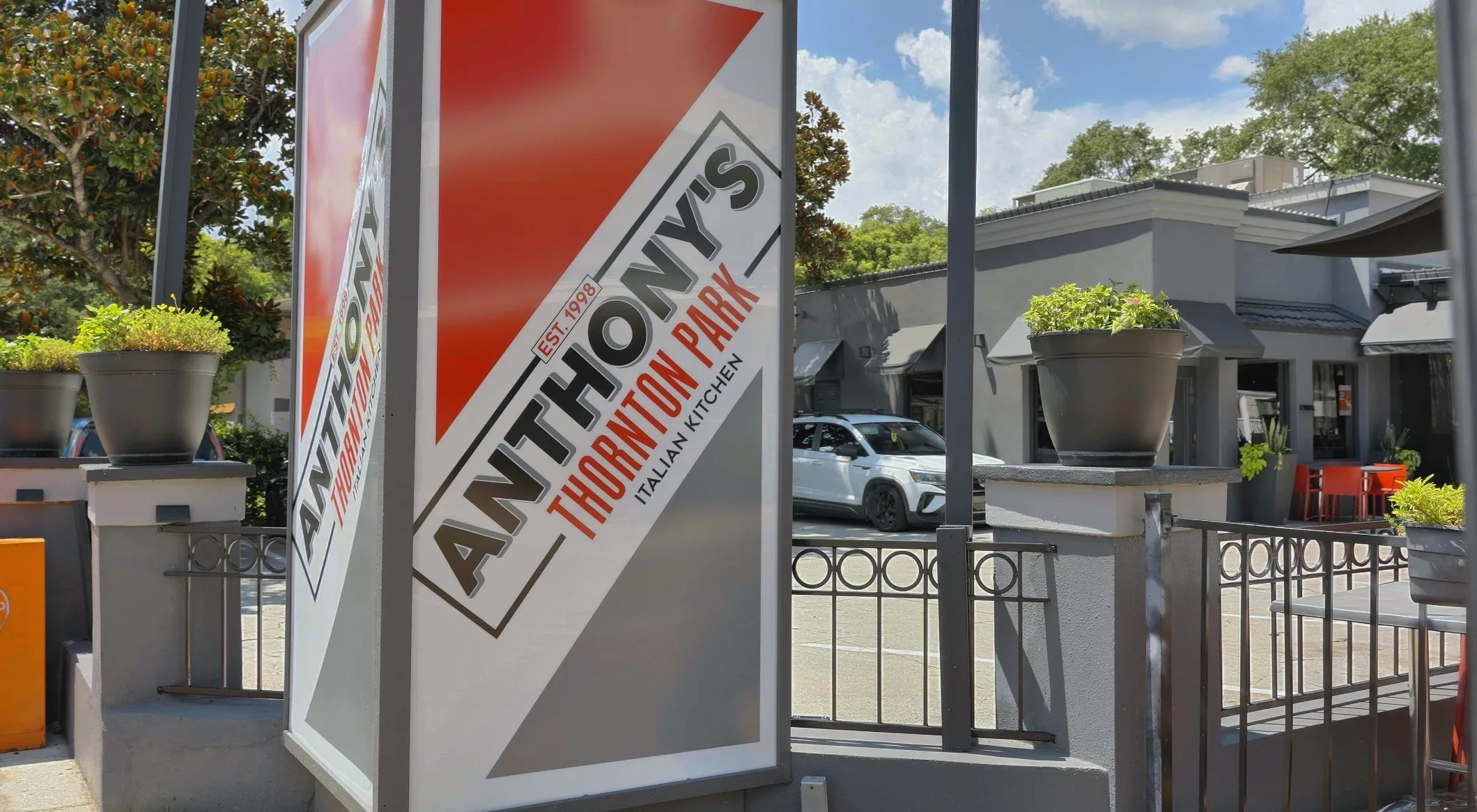
Thornton Park’s restaurant and cafe streets sit inside the Lake Lawsona historic district, east of Lake Eola.
What does it really cost to own a 70 to 100 year old home?
Older homes need a thorough inspection, item by item, and insurance alone can be a surprise.
Jared’s checklist: roof age, plumbing that could be cast iron or galvanized, electrical, the foundation and insurance. Our four-point inspection guide and our list of resale inspection traps in Orlando show what typically comes up. He estimates insurance in the older ZIP codes at roughly 4,000 to 6,000 dollars a year, versus a county average near 3,500 dollars. That is a model estimate, so get real quotes before you commit.
Near the lakes, look at the elevation of the specific parcel. Our explainer on flood zone X and flood insurance in Florida is a good starting point. If you are planning a renovation inside a historic district, it is also worth reading about the historic property tax exemption in Orlando.
Which historic downtown Orlando area matches the way you want to live?
Jared’s framing: the question is not which area ranks highest, it is which trade-off you would rather live with.
- The Main Street neighbor, College Park: walk to dinner and choice at every price. The trade-off is older systems and possibly a new build next door.
- The lake lot traditionalist, Orwin Manor or Rose Isle: a lake nearby, a quiet street and a pool. The trade-off is the highest price per square foot and very thin inventory.
- The old house purist, Lake Cherokee or Lake Eola Heights: a true 1920s home with character. The trade-off is historic review and lots of maintenance.
- The rebuild freedom buyer, Delaney Park or College Park: close in with room to renovate or build. The trade-off is competition.
- The park-the-car urbanist, Lake Eola Heights or Thornton Park: walk to the lake and restaurants. The trade-off is little or no yard and some event noise.
Jared says most of his clients know which one they are within 10 minutes of driving these streets. If you are still comparing in-town living with the suburbs, our guide to the real Orlando beyond the theme parks and our look at living in Winter Park are useful next reads.
A light real estate read
All four areas are short on supply and long on character, but they move at different speeds. The North Lakes and Delaney are moving quickly, College Park is reshaping itself through rebuilds, and the Eola and Thornton condo market is softer than the historic houses beside it. The price ranges above come from Jared’s own 12-month review, so treat them as directional and confirm any specific address before you make a decision.
The Takeaway
Living in historic downtown Orlando starts with picking the right ring. College Park gives you a main street and the most choice, the North Lakes give you water and mid-century pool homes, Delaney and Lake Cherokee put you minutes from downtown under two very different rule books, and Lake Eola Heights and Thornton Park let you live downtown on foot. Every one of them comes with older-home homework. If you want help matching an area to your budget and the way you live, the Jared Jones Team can walk these streets with you.
FAQ
Which neighborhoods count as historic downtown Orlando?
In Jared Jones’s guide, historic downtown Orlando means the older, close-in rings around downtown: College Park to the northwest, Orwin Manor and Rose Isle in the North Lakes, Delaney Park and Lake Cherokee to the south, and Lake Eola Heights and Thornton Park around Lake Eola. He uses official City of Orlando neighborhood boundaries, not ZIP codes.
Can older homes be torn down in College Park?
College Park has National Register historic districts, but Jared notes they work as an honor roll rather than a local design review district, so rebuilds are possible there. In his 12-month review, almost one in five College Park sales was a home built after 2021, while Lake Cherokee had none.
What do homes cost in historic downtown Orlando?
Jared’s 12-month review put College Park entry homes at roughly 350,000 to 500,000 dollars, North Lakes entry homes at about 650,000 to 900,000 dollars, Delaney and Lake Cherokee entry homes around 550,000 dollars, and Lake Eola Heights and Thornton Park houses starting near 450,000 to 600,000 dollars. Prices vary by street and condition, so confirm any specific address.
Which areas are City of Orlando local historic districts?
Lake Cherokee became a local historic district in 1981, Lake Eola Heights in 1989 and Lake Lawsona, which covers Thornton Park, in 1994, according to the City of Orlando. Exterior changes in those districts go through historic review. Delaney Park and College Park are not local historic districts.
What extra costs come with a 70 to 100 year old home?
Jared tells buyers to inspect the roof, plumbing that may be cast iron or galvanized, electrical, the foundation and insurance. He estimates insurance in the older ZIP codes at roughly 4,000 to 6,000 dollars a year versus a county average near 3,500 dollars, a model estimate that should be checked with real quotes, and he flags parcel elevation near the lakes.
Links and Sources
The Jared Jones Team guides
- Winter Garden and Horizon West real estate hub
- What is it like to live in Orlando’s historic neighborhoods? Quick answer
- Local historic district vs. the National Register in Orlando
- Do you need a certificate of appropriateness to renovate a historic Orlando home?
- Historic property tax exemption for renovating an Orlando home
- Four-point inspection in Florida: panel, wiring and AC problems
- Orlando resale home inspection traps
- Do homes in flood zone X need flood insurance?
- The real Orlando: choosing where to live beyond the theme parks
- East Orlando neighborhoods compared
- What it is like to live in Winter Park
- Living in Orlando in 2026
- What to know before moving to Orlando in 2026
Video
Sources
Thinking about buying or selling in historic downtown Orlando?
Get a straight read on which neighborhood, home and price tier fit your plans. Call or text 407-706-5000 or email info@jaredjones.com.