
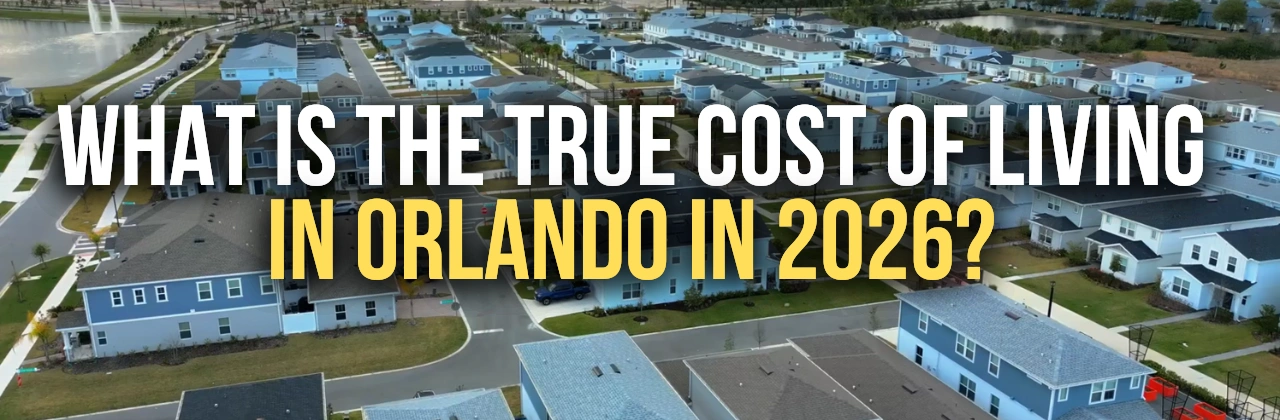
6 Key Highlights for the Cost of Living in Orlando in 2026
The cost of living in Orlando in 2026 is not just about the mortgage or rent. Buyers need to understand the full monthly picture, including housing, insurance, taxes, HOA fees, CDD fees, utilities, commuting, groceries, schools, and lifestyle costs.
Orlando Is Not One Cost-of-Living Number
Winter Garden, Lake Nona, Kissimmee, Davenport, Apopka, Clermont, and Dr. Phillips can all create very different monthly budgets based on home prices, fees, commute patterns, and lifestyle needs.
Housing Costs Are Only the Starting Point
Renters and buyers need to look beyond the headline price. A lower payment farther out can be offset by tolls, gas, commute time, maintenance, and extra vehicle costs.
Insurance and Taxes Can Surprise Buyers
Homeowners insurance, roof age, mitigation credits, county taxes, and purchase price can all change the real monthly cost. Buyers should estimate taxes from their purchase price, not the seller’s current bill.
HOA and CDD Fees Matter in Newer Areas
Newer communities in Horizon West, Wellness Way, Sunbridge, Lake Nona, and other growth corridors may include HOA and CDD fees that add to the true monthly cost.
Florida Summer Utilities Need a Real Budget
Orlando summers can push electric bills higher, especially in larger homes, pool homes, older properties, or homes with aging HVAC systems, poor insulation, or heavy air conditioning use.
Lifestyle Costs Add Up Quickly
Groceries, eating out, childcare, youth sports, school choices, entertainment, and weekend activities can meaningfully change the monthly cost of living in Central Florida.

What Is the True Cost of Living in Orlando in 2026?
The Quick Answer
The true cost of living in Orlando in 2026 depends heavily on where you live, how you commute, and what kind of home you buy. A buyer looking in Winter Garden or Lake Nona may face higher home prices, HOA fees, and CDD exposure, while a buyer in Kissimmee, Davenport, or Apopka may find better purchase prices but pay more in commute time, tolls, and transportation costs. A typical Orlando homeowner should budget beyond the mortgage for insurance, taxes, utilities, lawn care, possible pool care, tolls, groceries, and reserves. In many cases, the real monthly number can swing by $1,000+ per month depending on area and lifestyle.
Orlando is not one cost-of-living number. After 23 years in Central Florida real estate, nearly 4,000 transactions, and 200+ personal flips, I can tell you that the buyers who do well here are not always the ones with the biggest budget. They are the ones who understand the full monthly picture before they choose the house. In Winter Garden, Lake Nona, Davenport, Kissimmee, Clermont, Apopka, Dr. Phillips, and Windermere, the trade-offs are different. Some areas cost more up front. Others look cheaper until you add tolls, insurance, HOA fees, CDDs, utilities, and commute time. This 2026 breakdown is designed to help you avoid the budget surprises that show up after closing.
How Much Does Housing Really Cost in Orlando in 2026?
Housing is still the biggest Orlando cost, but the real answer depends on whether you rent, buy entry-level, buy in a family suburb, or push into a premium corridor. In 2026, the Orlando market has a wide spread between Kissimmee, Davenport, Apopka, Winter Garden, Lake Nona, Dr. Phillips, and Windermere.
A one-bedroom apartment in a mid-tier Orlando submarket may run roughly $1,400–$1,800/month. A two-bedroom in a nicer complex may land closer to $1,800–$2,400/month.
For single-family rentals, the range gets wider. A suburban home may start around $2,200–$2,300/month, while larger homes or more premium areas can push close to $4,000/month.
On the buying side, the first real entry point is often around $350,000–$400,000. At that level, buyers may be looking at older communities, smaller square footage, longer commutes, or homes needing updates.
Orlando Housing Cost Ranges in 2026
| Housing Type | Approximate 2026 Range | Likely Trade-Off |
|---|---|---|
| 1-bedroom apartment | $1,400–$1,800/month | Smaller space or mid-tier location |
| 2-bedroom apartment | $1,800–$2,400/month | Higher rent for newer or nicer complexes |
| Single-family rental | $2,200–$4,000/month | Area, size, schools, and condition vary heavily |
| Entry-level purchase | $350K–$400K | Older home, smaller size, or longer commute |
| Family sweet spot | $450K–$550K | HOA or CDD exposure likely in newer areas |
| Premium corridor | $600K+ | Higher price per square foot or older systems |
What Hidden Ownership Costs Catch Orlando Buyers Off Guard?
The biggest surprise for Orlando buyers is not usually the mortgage. It is the combination of insurance, property taxes, HOA fees, CDD fees, lawn care, pool care, and repair reserves. These costs can make two homes with the same purchase price feel completely different month to month.
Homeowners insurance is one of the first numbers to verify. For many $400K–$600K Metro Orlando homes, a solid policy may run around $2,500–$3,600/year. Roof age, construction type, wind mitigation, electrical updates, and year built can move that number quickly.
Property taxes are another area where buyers get misled. The seller’s current tax bill usually does not tell you what your tax bill will be after purchase. A new homestead buyer should often budget roughly 1.1%–1.5% of purchase price in year one.
HOAs and CDDs matter heavily in newer communities. HOA fees may run around $80–$180/month, while CDD fees can add roughly $1,700–$3,600/year on top of the tax bill in some areas.
Hidden Ownership Cost Checklist
- Insurance: Verify roof age, wind mitigation, electrical, plumbing, and carrier options.
- Taxes: Estimate based on your purchase price, not the seller’s current bill.
- HOA: Confirm monthly dues, transfer fees, capital contributions, and restrictions.
- CDD: Ask whether the community has a CDD and how much remains on the bond.
- Lawn/pest: Budget roughly $75–$175/month if hiring it out.
- Pool care: Budget around $100–$130/month for weekly service.
- Repairs: A conservative reserve is often 1% of home value per year.

How Much Should Orlando Homeowners Budget for Utilities?
Utilities in Orlando are seasonal. Summer is the expensive stretch because air conditioning runs hard from June through September. Winter is usually lighter because Central Florida households spend very little on heat compared with Chicago, Boston, New York, or other colder markets.
For an average single-family home in Metro Orlando, summer electric bills may run roughly $250–$350/month under normal conditions. Larger homes, pool homes, older HVAC systems, poor insulation, or lower thermostat settings can push the bill higher.
During peak months, some larger or less efficient homes may see electric bills closer to $400–$750/month. That does not mean every house will hit that range, but buyers need to understand the risk before choosing the home.
From October through May, the same household may drop closer to $80–$150/month for electricity. Water and sewer may run $60–$100/month, and internet may run $60–$90/month, depending on provider and area.
Utility Planning Callout
Budget higher for summer.
A realistic all-in utility budget for many Orlando households may be around $350–$550/month, depending on season, home size, pool, insulation, HVAC age, and municipality.
How Much Do Tolls, Gas, and Commuting Add to Orlando Living Costs?
Orlando is car dependent. If you live in the wrong location for your daily life, the “cheaper” house can quietly become more expensive through tolls, gas, vehicle wear, and lost time. This is especially important when comparing Davenport, Clermont, Winter Garden, Lake Nona, and Apopka.
A SunPass commuter using major toll roads like 429, 417, 528, or the Turnpike may spend $150–$300/month in tolls alone. That is before gas, auto insurance, maintenance, and the cost of a second car.
For a two-car household with real commutes, transportation can potentially reach $700–$1,200/month. That number can be lower for remote workers, but it can be very real for families commuting across multiple corridors.
This is why I tell buyers to run Google Maps at 7:45 AM on a Tuesday, not Saturday afternoon. The house may look like a deal on Zillow, but the actual commute can change your life.
Commute Takeaways
- Test the drive during real commute windows.
- Price out tolls before choosing the cheaper house.
- Compare travel time from the home to work, school, airport, Disney, and daily errands.
- Do not assume 20 miles means the same thing in every Orlando corridor.
- Remote workers have more flexibility, but still need to think through schools, errands, and lifestyle access.

How Do Schools, Childcare, and Family Costs Change the Orlando Budget?
For relocating families, school decisions can change the entire Orlando budget. Areas like Winter Garden, Windermere, Dr. Phillips, and parts of Lake Nona often attract family buyers, but the housing cost can be higher. Cheaper areas may require a closer look at school zones, commute, and private school alternatives.
Private school can be a major budget item. Depending on the school, grade level, and program, a family may need to budget roughly $12,000–$22,000 per child per year.
Florida also has education scholarship options that may help offset private or alternative education costs. Some programs may offer potential offsets of roughly $7,000–$8,000 per year per child, depending on eligibility, program rules, and current funding.
Childcare is another major line item. Daycare for one child in Metro Orlando may run roughly $1,200–$2,000/month, depending on the child’s age and facility. For two children, that becomes a serious household planning issue.
Family Budget Items to Verify
- Public school zone assigned to the exact address.
- Private school tuition by grade level.
- Scholarship eligibility and reimbursement timing.
- Childcare cost by age and facility.
- Youth sports, camps, and extracurricular costs.
- Commute from home to school and activities.
What Should Orlando Buyers Expect for Groceries and Lifestyle Spending?
Groceries and lifestyle spending are where many Orlando families leak money after the move. The mortgage may be planned, but Publix runs, Costco trips, restaurants, youth sports, theme park weekends, gyms, and entertainment can add up quickly.
A household of four shopping mostly at Publix may spend roughly $800–$1,100/month on groceries. Families who mix Costco, Aldi, Walmart, and Publix can often manage that number more aggressively.
Eating out can be the bigger issue. Orlando has a strong restaurant scene, and the weather makes it easy to go out year-round. A household eating out 3–4 times per week may add $800–$1,500/month, depending on family size and restaurant choices.
Entertainment, gyms, and weekly activities can add another $150–$300/month. For families with youth sports, rec leagues, camps, and extracurriculars, budget roughly $300–$600/month during peak activity seasons.
Lifestyle Spending Callout
The cost of living in Orlando is not only about the house. It is also about how often you drive, where you grocery shop, how much you eat out, whether your kids are in activities, and how close you live to the places you actually use every week.

Which Orlando Areas Cost the Most, and What Are the Trade-Offs?
The Orlando area that “costs the most” depends on what you value. Dr. Phillips, Windermere, Winter Park, Lake Nona, Winter Garden, Horizon West, Clermont, Minneola, Apopka, Kissimmee, St. Cloud, and Davenport all have different price, commute, school, and lifestyle trade-offs.
Winter Garden and Horizon West offer strong suburban lifestyle infrastructure, newer homes, and desirable schools, but buyers need to watch HOA fees, CDDs, and 429 commute patterns.
Clermont and Minneola may offer more value per square foot than Winter Garden, with hills, lakes, and growth, but eastbound commute time and tolls can become part of the real cost.
Lake Nona is a premium master-planned corridor with Medical City, schools, and amenities, but pricing and CDD exposure can be meaningful. Kissimmee, St. Cloud, and Davenport may offer more affordability, but commute and tourism-corridor overlap need to be understood.
Orlando Submarket Trade-Off Snapshot
| Area | Best Fit | Main Cost Advantage | Main Trade-Off |
|---|---|---|---|
| Winter Garden / Horizon West | Families wanting newer suburbs | Strong schools and lifestyle access | HOA/CDD fees and 429 commute |
| Clermont / Minneola | Buyers wanting space and lake lifestyle | More value than some western suburbs | Longer eastbound commute |
| Apopka | Buyers wanting newer homes with value | Northwest growth corridor | Infrastructure catching up |
| Lake Nona | Medical, defense, tech, and airport-area buyers | Master-planned amenities | Premium pricing and CDD exposure |
| Kissimmee / St. Cloud | Price-sensitive buyers | Lower entry points | Commute planning and area variation |
| Davenport / Polk Growth Areas | Remote or flexible workers | Newer builds and square footage value | Longer commutes and STR overlap |
| Dr. Phillips / Windermere | Premium location and schools | Established core locations | Higher price per square foot and older homes |

What Does a Realistic Monthly Orlando Budget Look Like?
A realistic Orlando budget has to include the mortgage or rent, insurance, taxes, HOA, CDD, utilities, transportation, groceries, childcare, activities, lifestyle, and reserves. The goal is not to guess the mortgage payment alone. The goal is to understand the full monthly number before choosing the home.
For a single renter, a sample budget may include around $1,750/month for rent, $300/month for utilities, $500/month for transportation, and $700/month for groceries and lifestyle. That brings the sample monthly total to roughly $3,250/month.
For a couple buying a $375,000 starter home, the estimated monthly cost can land just over $6,000/month once mortgage, taxes, insurance, HOA, utilities, transportation, groceries, and lifestyle are included.
For a household of four buying around $475,000 in a newer community with an HOA and CDD, the monthly number can approach $8,000/month. For a premium household buying around $700,000 with 20% down, the all-in number may land just under $9,000/month.
Budget Scenarios from the Transcript
| Scenario | Housing Assumption | Estimated Monthly Reality |
|---|---|---|
| Single renter | 1-bedroom apartment around $1,750/month | About $3,250/month based on itemized math |
| Couple buying starter home | $375K purchase | Just over $6,000/month |
| Household of four | $475K newer community with HOA/CDD | Approaching $8,000/month |
| Premium household | $700K purchase with 20% down | Just under $9,000/month |
Frequently Asked Questions About the Cost of Living in Orlando in 2026
The cost of living in Orlando in 2026 depends on much more than the mortgage payment. These are the key questions buyers should ask before choosing areas like Winter Garden, Lake Nona, Kissimmee, Davenport, Apopka, Clermont, Dr. Phillips, Windermere, or St. Cloud.
Is Orlando still affordable in 2026?
Orlando is not the bargain it was 10 years ago, but it is also not one uniform market. A buyer in Kissimmee, St. Cloud, Apopka, or Davenport may find a lower entry point than someone shopping Windermere, Dr. Phillips, Winter Park, or Lake Nona. The bigger issue is not just affordability; it is predictability. You need to know the full monthly number before buying. That means estimating insurance, property taxes, HOA, CDD, utilities, transportation, maintenance, groceries, and lifestyle. Orlando can still work well for the right household, but the days of casually buying without running the full math are over.
How much income do you need to live comfortably in Orlando?
The answer depends on whether you rent, buy, commute, have children, or choose a premium area. A single renter may need around $4,000/month net income to live comfortably, while a household of four in a newer Orlando-area community may need around $9,000–$10,000/month net income. A higher-income household buying in a premium submarket like Dr. Phillips, Windermere, or Lake Nona may need closer to $11,000–$12,000/month net income. These are planning ranges, not guarantees. The real number depends on debt, down payment, insurance, taxes, commute, childcare, and lifestyle.
What is the biggest hidden cost of living in Orlando?
For many buyers, the biggest hidden cost is not one item. It is the combination of insurance, taxes, HOA fees, CDD fees, utilities, and transportation. A home in Horizon West or Lake Nona may have higher HOA or CDD exposure, while a home farther out in Davenport, Clermont, or Minneola may have more tolls and commute time. Insurance can also change dramatically based on roof age, wind mitigation, electrical updates, and year built. The mistake is comparing two homes only by purchase price. In Orlando, the cheaper house is not always cheaper once you run the full monthly cost.
Are property taxes high in Orlando?
Property taxes in Metro Orlando are not something buyers should guess from Zillow. The seller’s current tax bill usually does not tell you what your bill will be after purchase. A new homestead buyer in Orange, Seminole, Lake, or Polk County may need to budget roughly 1.1%–1.5% of the purchase price in year one. Orange County city areas may trend toward the higher side, while Seminole may be lower, and Lake or Polk may fall more toward the middle. The key is to estimate taxes based on your likely purchase price and local millage, not the current owner’s protected assessment.
How expensive is homeowners insurance in Orlando?
Homeowners insurance in Orlando has improved from the worst of the recent Florida insurance crisis, but it remains one of the most important numbers to verify before buying. For many $400K–$600K Metro Orlando homes, a solid policy may run around $2,500–$3,600/year. That number can change based on roof age, wind mitigation credits, construction type, year built, electrical system, plumbing, and claims history. A newer roof in Winter Garden, Lake Nona, or Apopka may price differently than an older roof in an established area. Always get quotes early, not after inspection panic sets in.
Are CDD fees common in Orlando?
CDD fees are common in many newer master-planned or growth-area communities, especially in places like Horizon West, Wellness Way, Sunbridge, Lake Nona, and parts of newer suburban Orlando. A CDD is separate from the HOA and often helps repay infrastructure costs like roads, utilities, and amenities over time. A CDD can add roughly $1,700–$3,600/year on top of the tax bill in some areas. Some buyers only see the listing price and HOA, then later realize the CDD changes the monthly payment. Before buying new construction or newer resale, ask for the CDD disclosure and add it into the total.
How much are utilities in Orlando during the summer?
Summer utilities in Orlando can surprise buyers coming from the Northeast, Midwest, or Pacific Northwest. From June through September, air conditioning runs hard. Average single-family electric bills may run around $250–$350/month under normal conditions. Larger homes, pool homes, older HVAC systems, poor insulation, or aggressive cooling habits may push bills toward $400–$750/month during peak months. The offset is that winter heating costs are usually very low. In areas like Winter Garden, Clermont, Kissimmee, and Lake Nona, the home’s size, age, insulation, and HVAC condition matter as much as the city.
Is commuting expensive in Orlando?
Yes, commuting can be expensive in Orlando because the region is car dependent. If you use toll roads like 429, 417, 528, or the Turnpike, tolls alone may run $150–$300/month for some commuters. A two-car household with real daily commuting may face $700–$1,200/month in total transportation costs when gas, tolls, maintenance, and insurance are included. This matters when comparing Davenport versus Dr. Phillips, Clermont versus Winter Garden, or St. Cloud versus Lake Nona. Always test the real commute at weekday rush hour before choosing the house.
Which Orlando areas are most expensive to live in?
The premium areas tend to include Dr. Phillips, Windermere, Winter Park, Lake Nona, and parts of Winter Garden and Horizon West. These areas often offer stronger location advantages, school appeal, amenities, or access to major employment corridors, but the cost shows up in price per square foot, HOA or CDD fees, or older-home maintenance. More affordable entry points may appear in Kissimmee, St. Cloud, Apopka, Davenport, and parts of Polk County. The trade-off is usually commute, infrastructure, school variation, or distance from core Orlando employment centers. The right area depends on your life, not just the lowest payment.
Should I rent first before buying in Orlando?
Renting first can make sense if you do not understand the Orlando area yet, especially if you are choosing between very different submarkets like Lake Nona, Winter Garden, Clermont, Kissimmee, and Dr. Phillips. The downside is that rents are not cheap, and moving twice has a cost. One-bedroom apartments may run around $1,400–$1,800/month, two-bedrooms around $1,800–$2,400/month, and single-family rentals from about $2,200–$4,000/month. If you rent first, use that time aggressively. Test commutes, schools, grocery patterns, toll roads, weekend routines, and neighborhood fit before buying.

Why Choose Jared Jones?
As a top real estate agent with nearly 4,000 homes sold and over 20 years of experience in the Florida real estate market, I have the expertise needed to help you navigate today’s evolving landscape. Whether you’re looking to buy or sell, my deep understanding of market trends and personalized approach will provide you with the insights and strategies required for success.
Best Realtor in Orlando - Reach Out Today
If you’re ready to make a move in Florida’s real estate market, don’t hesitate to reach out. Contact Jared Jones at 407-706-5000 (call or text) or email info@jaredjones.com for professional guidance and personalized service that will help you achieve your real estate goals.
Trustindex verifies that the original source of the review is Google. Heidi was incredibly helpful and kind during the entire process. She negotiated effectively for us and was always reachable whenever we had a question and now we live in our dream home!Posted on GoogleTrustindex verifies that the original source of the review is Google. Heidi and Jared are amazing realtors. I would recommend them to anyone looking.Posted on GoogleTrustindex verifies that the original source of the review is Google. Heidi was awesome! She always took the time to answer all my questions and went above and beyond to help us. We were a little more complicated because we moved from Alaska to Florida and she helped navigate the whole process and made it so much smoother.Posted on GoogleTrustindex verifies that the original source of the review is Google. Stephany Cornelius our realtor is AMAZING. We initially reached out to Jared Jones who is amazing as well by the way super professional, and he connected us with Stephany. She is such a star. She treated me and my family (kids) with so much love, care and professionalism that I am thoroughly impressed with her. She was there with us and for us every step of the way. She became family. We love her so much and we will deeply recommend using them for finding a home.Posted on GoogleTrustindex verifies that the original source of the review is Google. Selling a home from overseas could have been stressful, but Jared and his team made the whole process feel incredibly straightforward. From the very beginning we felt we were in safe hands. Jared was always approachable, responsive and happy to answer any questions we had. His communication was excellent throughout, keeping us updated every step of the way, and his advice was always honest and reassuring. The professional photography and video marketing were first class and really showed our Davenport home at its very best. What impressed us most was how much Jared genuinely cared about achieving the best possible outcome for us. Even when unexpected issues arose during the sale, he remained calm, proactive and worked hard to keep everything moving towards a successful closing. We couldn’t have asked for a better Realtor and would wholeheartedly recommend Jared Jones and his team to anyone buying or selling a home in the Davenport and Central Florida area. Thank you, Jared, for all your hard work, professionalism and support—it has been a pleasure working with you.Posted on GoogleTrustindex verifies that the original source of the review is Google. My husband discovered Jared on social media while we were looking for homes in Florida. He reached out when we were ready to get serious and we are so thankful we did! He made finding our home and all that goes with buying and relocating so much smoother. He hooked us up with a great lender (Cross Country Mortgage) and anything else we needed. Highly recommend Jared Jones!Posted on GoogleTrustindex verifies that the original source of the review is Google. My wife and I purchased a home in Kissimmee, Florida and it was by far the best home buying experience we have ever had. This is our 7th home we have purchased. Stephany Cornelius was our Realtor from Jared Jones Real Estate Team and we couldn't have been more pleased. She made the process so easy, less stressful and guided us through every aspect including a very quick closing. I highly recommend Stephany if you're trying to navigate the home buying experience here in Florida.Posted on GoogleTrustindex verifies that the original source of the review is Google. Jared Jones was amazing at helping us pick and getting our dream home. He was very patient and always had an answer to any questions we had. Could not be more thankful for him and his team.Posted on GoogleTrustindex verifies that the original source of the review is Google. Jared and his team were great to work with. Always professional and responsive to every situation that arose. Would love to work with them again on future deals.Posted on GoogleTrustindex verifies that the original source of the review is Google. Jared and Kristen were a pleasure to deal with. Their professionalism and quick responses made the entire closing process smooth and stress-free. I look forward to working with them again on future transactionsVerified by TrustindexTrustindex verified badge is the Universal Symbol of Trust. Only the greatest companies can get the verified badge who has a review score above 4.5, based on customer reviews over the past 12 months. Read more
Search Homes in Orlando, Florida




Jared Jones Real Estate Team Serving All of Central Florida
- Osceola County
- Orange County
- Lake County
- Polk County
- Seminole County
- Volusia County
- Broward County
- Marion County
- Flagler County
- Brevard County
- Pinellas County
- Hillsborough County