
Inside Green District: The $2 Billion Smart City Envisioned for Historic Parramore
A Parramore native has laid out a sweeping vision for his childhood neighborhood: a connected, technology-driven district with housing, hotels, a grocery store and rooftop pads for electric air taxis. The developer puts the full buildout near $2 billion and is aiming for a summer 2027 groundbreaking, though the City of Orlando says the expanded plan is still in its earliest review stage.
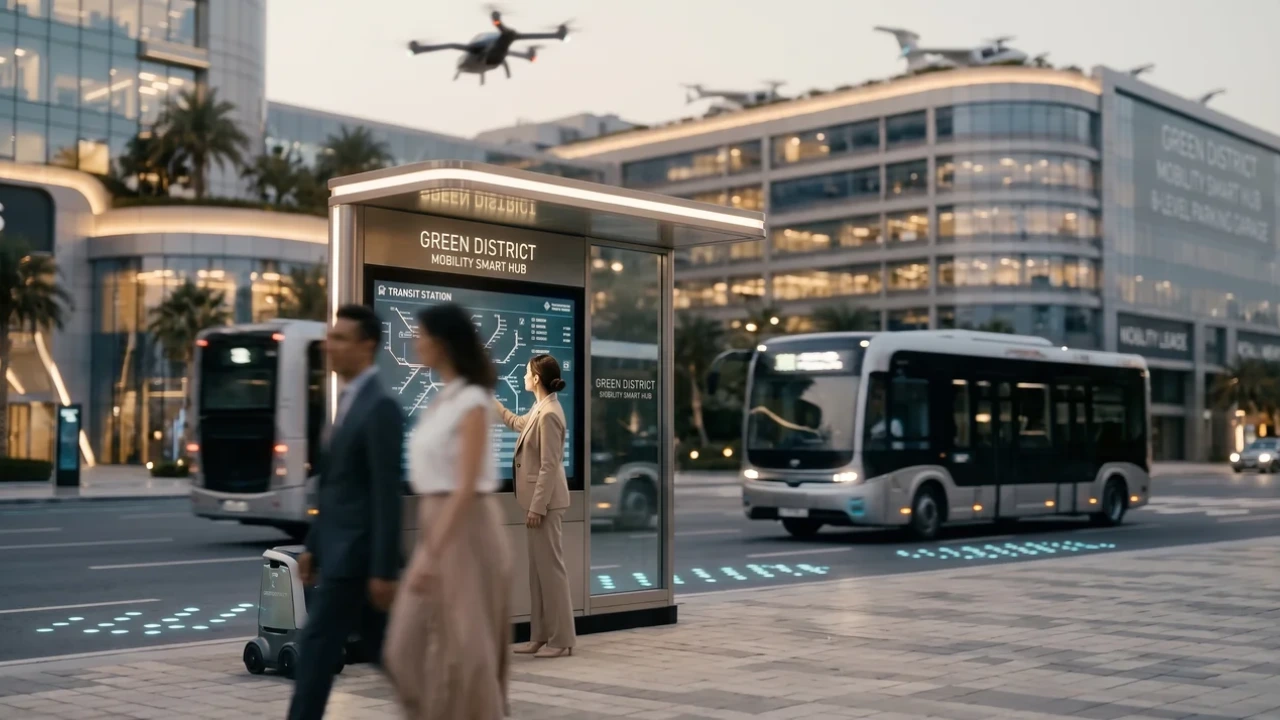
A rooftop vertiport concept for the proposed Green District Smart City in Parramore, where the plan calls for electric air taxis to eventually land and take off. Conceptual rendering only; the final design may change.
Image: Green District Smart City
What to Know
The Green District proposal in brief
An early-stage pitch for one of downtown Orlando’s most historic neighborhoods, built around mobility, mixed-income housing and a nod to Parramore’s past.
A roughly $2 billion vision. The full buildout would layer housing, hotels, retail, a grocery store, transit and advanced air mobility across Parramore, with a summer 2027 groundbreaking target.
Two Smart Hubs anchor it. Parking structures at 17 N. Westmoreland Drive and 320 W. Clear Lake Street would double as mobility hubs, pairing decks with retail, transit links and EV charging.
Still early in City review. A pre-application meeting has been held, but Orlando officials say no formal application for the expanded project has been filed yet.
Orlando’s Parramore neighborhood could be in line for one of the most ambitious redevelopment pitches the area has seen in years. Developer Tim Green, who spent part of his childhood in the community, has outlined a mixed-use district that would fold housing, hotels, retail, a grocery store, transit and even electric aircraft into a single connected footprint just west of downtown.
Green has cast the effort as a chance to direct new homes, employment, mobility options and outside investment into the neighborhood where his grandparents once lived. By his own account, the long-term footprint could reach roughly 200 acres and represent close to $2 billion at full buildout, positioning the area as a testbed for smart-city ideas on the edge of the urban core.
A district built around Smart Hubs
At the center of the concept are two Smart Hub structures, one at 17 N. Westmoreland Drive and another at 320 W. Clear Lake Street. Rather than conventional garages, each is designed to blend parking decks with ground-floor retail, connections to public transit and EV charging, turning storage for cars into a broader mobility node for residents, workers and visitors.
The plan pairs those hubs with a separate building set aside for health and wellness services, emergency response and air-transport support. The district is being designed by Atlanta-based firm Cooper Carry, tasked with weaving the transportation systems and mixed-use elements into one cohesive neighborhood plan.
Rooftop vertiports and electric air taxis
The most eye-catching piece looks well into the future. The proposal reserves rooftop space for vertiports, the landing and takeoff pads for electric vertical takeoff and landing aircraft, commonly shortened to eVTOLs. As advanced air mobility networks mature, those pads could one day connect the district to the wider Orlando region by air.
To get there, the development names Eve Air Mobility as its preferred air-mobility partner and eVTOL provider, working alongside i-charging USA on charging infrastructure and aircraft technology. For now, this remains a forward-looking layer of the plan rather than anything with a firm timeline.

Housing, hotels and a nod to Parramore’s history
Beyond mobility, later phases sketch out a fuller neighborhood: a grocery store, four hotels, expanded housing, conference space, restaurants, retail, entertainment and a museum. Housing is described as a core component, blending attainable and workforce rentals with paths to homeownership, though the developer has not yet released unit counts or specific affordability levels.
Three of the four hotel concepts are meant to honor Parramore’s Black history. Plans reference a Wells Hotel, a Sadler Hotel and a Green Book Hotel, the last named for the travel guide published from 1936 to 1966 that helped Black travelers find safe, welcoming places to stay during the Jim Crow era. Frank Wells of Bright Community Trust has described the aim as a genuinely mixed-income community, where deeply affordable rentals and attainable ownership sit alongside jobs, retail and other investment.
Where the plan stands with the City
The developer has filed what is billed as a Live Local Master Plan, leaning on Florida’s Live Local Act, which can ease certain local restrictions when affordable housing is included. City officials, however, say a pre-application meeting is as far as the expanded project has gone, and that no formal application has been submitted to date.
One open question involves a City-owned parcel at 925 W. Church Street, where the plan imagines a parking garage with ground-floor retail and a walkway to the proposed grocery store. Orlando says the developer is not authorized to use that site and would need another pre-application meeting to sort out the process, while the development team maintains the project can move forward without it. Green has been active in Parramore before, appearing on a 2024 development application for 1016 W. Church Street under Parramore City Towers LLC and pointing to two earlier hotel proposals that drew City approvals that year.
The expanded plan is expected to eventually go before Orlando’s Municipal Planning Board. Green has acknowledged the long-standing worry that large, high-end projects can accelerate displacement, and has said the effort will include community meetings and outreach so current residents can access the housing, jobs and support the district is meant to create.
Green District by the numbers
The figures are worth noting because they signal the sheer scale of what is being floated for a compact, historic neighborhood on downtown’s doorstep.
A light real estate read on the project
For Parramore, a pitch of this size is a signal worth watching even at this early stage. The neighborhood sits within walking distance of Kia Center, Creative Village and the downtown core, and interest at this scale reflects how much attention the area west of I-4 has drawn as downtown Orlando keeps expanding.
The real story here is balance. A district promising deeply affordable housing alongside hotels and air taxis will be judged on whether longtime residents actually benefit, and that tension between investment and displacement is one to follow closely as the plan moves through City review rather than something to read as a finished outcome.
The Takeaway
Green District is a big, headline-grabbing vision, and it is important to keep its status in view: an early-stage concept that has cleared a pre-application meeting but not a formal application. The eVTOL pads, four hotels and grocery store are aspirations at this point, not approvals.
What makes it worth tracking is the mix. If the housing commitments hold and the community engagement is real, a plan rooted in Parramore’s history could reshape one of Orlando’s most watched neighborhoods. The next milestone to watch is whether a formal application reaches Orlando’s Municipal Planning Board ahead of that summer 2027 target.
FAQ
What is Green District Smart City?
It is a proposed mixed-use district for Orlando’s Parramore neighborhood that would combine housing, hotels, retail, a grocery store, transit and advanced air mobility. Developer Tim Green estimates the full buildout at close to $2 billion.
Where would it be built?
In the historic Parramore neighborhood just west of downtown Orlando. Two Smart Hub structures are proposed at 17 N. Westmoreland Drive and 320 W. Clear Lake Street, with a long-term footprint the developer describes as roughly 200 acres.
Are flying taxis really part of the plan?
Yes, as a forward-looking layer. The plan reserves rooftop vertiports for electric vertical takeoff and landing aircraft, or eVTOLs, in partnership with Eve Air Mobility and i-charging USA, to be phased in as advanced air mobility networks develop.
Has the City of Orlando approved it?
Not yet. City officials say a pre-application meeting has been held but no formal application for the expanded project has been submitted. The plan is expected to eventually go before Orlando’s Municipal Planning Board.
When could it break ground?
The developer is targeting a summer 2027 groundbreaking and maintains the current review process will not change that goal, though the timeline depends on the project clearing City review.
External Links & Related Reading
For readers who want to review the reporting, the master plan announcement and the partners behind the proposal, these are the key references.
- Bungalower: A $2 Billion ‘Smart City’ with Flying Vehicles Proposed for Parramore
- Green District Smart City — Master Plan Announcement (PR Newswire)
- Eve Air Mobility — Air Mobility Partner
- i-charging USA — Charging and Aircraft Technology Partner
- Bright Community Trust — Housing Partner
- Cooper Carry — Master Plan Designer
- City of Orlando — Official Website
Watching Parramore’s next chapter?
Big development stories like Green District say a lot about where downtown Orlando’s buyer base is heading. When a move is on your radar, local context matters.